
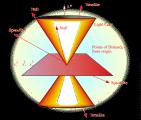
Introduction to Differential Geometry and General Relativity
by Stefan Waner
2005
Number of pages: 138
Description:
From the table of contents: distance, open sets, parametric surfaces and smooth functions, smooth manifolds and scalar fields, tangent vectors and the tangent space, contravariant and covariant vector fields, tensor fields, Riemannian manifolds, locally Minkowskian manifolds, covariant differentiation, geodesics and local inertial frames, the Riemann curvature tensor, comoving frames and proper time, the stress tensor and the relativistic stress-energy tensor, three basic premises of general relativity, the Einstein field equations and derivation of Newton's law, the Schwarzschild metric and event horizons, White Dwarfs, neutron stars and black holes.
Download or read it online for free here:
Download link
(1.7MB, PDF)
Similar books
 Dynamical and Hamiltonian Formulation of General Relativity
by Domenico Giulini - arXiv.org
This text introduces the reader to the reformulation of Einstein's field equations of General Relativity as a constrained evolutionary system of Hamiltonian type and discusses some of its uses, together with some technical and conceptual aspects.
(5501 views)
 Schwarzschild and Kerr Solutions of Einstein's Field Equation: an introduction
by Christian Heinicke, Friedrich W. Hehl - arXiv
Starting from Newton's gravitational theory, we give a general introduction into the spherically symmetric solution of Einstein's vacuum field equation, the Schwarzschild solution, and into one specific stationary solution, the Kerr solution.
(7935 views)
 Advanced General Relativity
by Sergei Winitzki - Google Sites
Topics include: Asymptotic structure of spacetime, conformal diagrams, null surfaces, Raychaudhury equation, black holes, the holographic principle, singularity theorems, Einstein-Hilbert action, energy-momentum tensor, Noether's theorem, etc.
(12011 views)
 Beyond partial differential equations: A course on linear and quasi-linear abstract hyperbolic evolution equations
by Horst R. Beyer - arXiv
This course introduces the use of semigroup methods in the solution of linear and nonlinear (quasi-linear) hyperbolic partial differential equations, with particular application to wave equations and Hermitian hyperbolic systems.
(13745 views)