
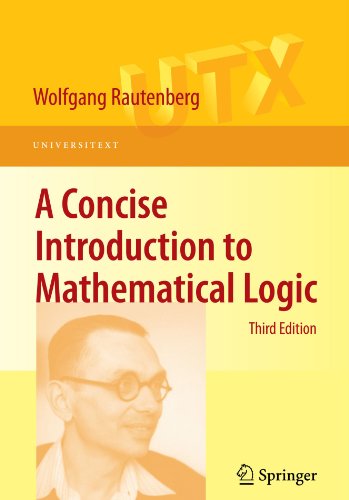
A Concise Introduction to Mathematical Logic
by Wolfgang Rautenberg
Publisher: Springer 2009
ISBN/ASIN: 1441912207
ISBN-13: 9781441912206
Number of pages: 131
Description:
The textbook by Professor Wolfgang Rautenberg is a well-written introduction to the beautiful and coherent subject of mathematical logic. It contains classical material such as logical calculi, beginnings of model theory, and Goedel's incompleteness theorems, as well as some topics motivated by applications, such as a chapter on logic programming.
Download or read it online for free here:
Download link
(1.5MB, PDF)
Similar books
 forall x: An Introduction to Formal Logic
by P.D. Magnus
An introduction to sentential logic and first-order predicate logic with identity, logical systems that influenced twentieth-century analytic philosophy. The book should help students understand quantified expressions in their philosophical reading.
(18334 views)
 A Problem Course in Mathematical Logic
by Stefan Bilaniuk
An introduction to mathematical logic for undergraduates. It supplies definitions, statements of results, and problems, along with some explanations, examples, and hints. The idea is to learn the material by solving the problems.
(21734 views)
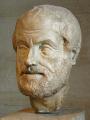 Formal Logic
- Wikibooks
An undergraduate college level textbook covering first order predicate logic with identity but omitting metalogical proofs. The first rules of formal logic were written over 2300 years ago by Aristotle and are still vital.
(14862 views)
 A Friendly Introduction to Mathematical Logic
by Christopher C. Leary, Lars Kristiansen - Milne Library Publishing
In this book, readers with no previous study in the field are introduced to the basics of model theory, proof theory, and computability theory. The text is designed to be used either in an upper division undergraduate classroom, or for self study.
(9096 views)